
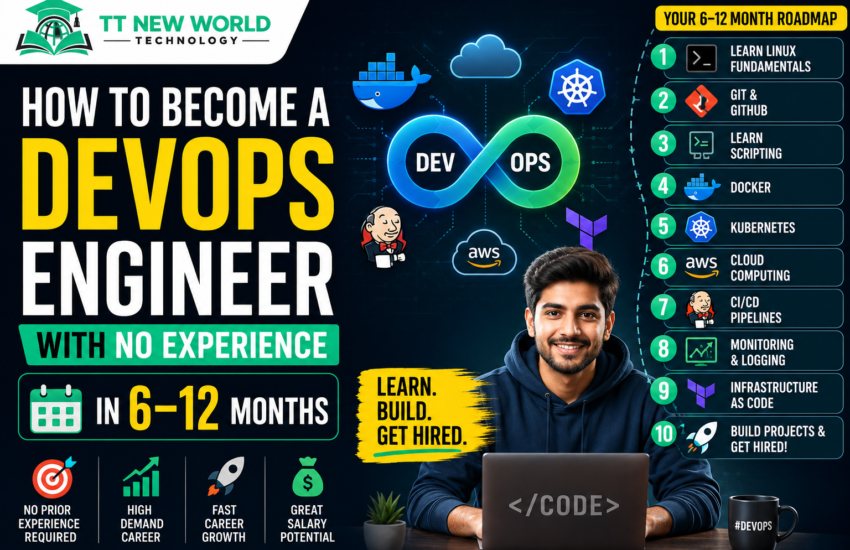
The demand for DevOps Engineers has never been higher. As businesses continue to adopt cloud computing, automation, and continuous software delivery, organizations are actively searching for professionals who can bridge the gap between software development and IT operations.
The best part? You don’t need years of experience or a computer science degree to get started.
With the right learning plan, hands-on practice, and commitment, it’s entirely possible to build the skills needed to land your first DevOps role within 6 to 12 months.
In this guide, we’ll walk you through a practical roadmap—from learning Linux and cloud fundamentals to building real-world projects and preparing for job interviews. Whether you’re a complete beginner, an IT support professional, or someone looking to transition into tech, this roadmap will help you get there.
Table of Contents
- What Does a DevOps Engineer Do?
- Can You Become a DevOps Engineer Without Experience?
- Skills You Need
- The 6–12 Month Roadmap
- Hands-On Projects
- Certifications
- Building Your Portfolio
- Resume and Interview Tips
- Common Mistakes to Avoid
- Salary Expectations
- Frequently Asked Questions
- Final Thoughts
What Does a DevOps Engineer Do?
A DevOps Engineer helps development and operations teams work together more efficiently by automating software delivery, managing cloud infrastructure, and ensuring applications are reliable, secure, and scalable.
Typical responsibilities include:
- Managing cloud infrastructure
- Building CI/CD pipelines
- Automating deployments
- Managing Docker containers
- Deploying Kubernetes clusters
- Monitoring applications
- Writing automation scripts
- Implementing Infrastructure as Code (IaC)
- Troubleshooting production issues
- Improving system reliability
DevOps Engineers work with developers, testers, security teams, and system administrators to deliver software faster and more reliably.
Can You Become a DevOps Engineer Without Experience?
Yes.
Many successful DevOps professionals started with little or no prior experience.
The key is to focus on:
- Learning the fundamentals
- Building practical projects
- Practicing consistently
- Creating a portfolio that demonstrates your skills
Employers value candidates who can show they understand real-world tools and workflows, even if they haven’t worked in a formal DevOps role before.
Skills Every DevOps Engineer Needs
Before diving into tools, it’s important to understand the core skills behind DevOps.
You should become comfortable with:
- Linux administration
- Networking basics
- Cloud computing
- Version control (Git)
- Scripting (Bash or Python)
- Containers
- Kubernetes
- Infrastructure as Code
- CI/CD pipelines
- Monitoring and logging
- Security fundamentals
These skills form the foundation of a successful DevOps career.
A Practical 6–12 Month Roadmap
Month 1: Learn Linux Fundamentals
Linux powers most cloud servers and production environments.
Focus on:
- File system navigation
- User and group management
- File permissions
- Package management
- Process management
- Shell commands
- SSH
- Cron jobs
- Networking basics
Practice daily by using Ubuntu, Rocky Linux, or Amazon Linux in a virtual machine.
Month 2: Learn Git and GitHub
Version control is essential.
Learn how to:
- Initialize repositories
- Commit changes
- Create branches
- Merge branches
- Resolve conflicts
- Push to GitHub
- Create Pull Requests
By the end of the month, host all your practice projects on GitHub.
Month 3: Learn Scripting
Automation is at the heart of DevOps.
Start with:
Bash
Automate Linux tasks such as:
- User creation
- Backups
- Log cleanup
- System monitoring
Python
Learn:
- Variables
- Loops
- Functions
- File handling
- APIs
- Automation scripts
You don’t need to become a software developer, but basic scripting skills are essential.
Month 4: Learn Docker
Containers are a cornerstone of modern DevOps.
Master:
- Images
- Containers
- Dockerfiles
- Docker Compose
- Volumes
- Networking
- Docker Hub
Project Idea:
Containerize a simple web application and deploy it locally.
Month 5: Learn Kubernetes
Once you understand Docker, move to Kubernetes.
Focus on:
- Pods
- Deployments
- Services
- ReplicaSets
- ConfigMaps
- Secrets
- Namespaces
- Ingress
- Rolling Updates
Deploy your Dockerized application to a Kubernetes cluster using Minikube or Kind.
Month 6: Learn Cloud Computing
Choose one cloud platform to begin with.
For most learners, AWS is an excellent starting point.
Learn:
- EC2
- S3
- IAM
- VPC
- RDS
- CloudWatch
- Load Balancers
Understand how cloud services support scalable, secure applications.
Month 7: Learn Infrastructure as Code
Manual infrastructure creation doesn’t scale.
Learn Terraform to provision cloud resources using code.
Create:
- Virtual Machines
- Networks
- Security Groups
- Storage Buckets
Store your Terraform code in GitHub.
Month 8: Learn CI/CD
Understand how software moves from a developer’s laptop to production.
Practice with:
- Jenkins
- GitHub Actions
- GitLab CI/CD
Build pipelines that:
- Pull code from Git
- Run automated tests
- Build Docker images
- Deploy to Kubernetes
Month 9: Learn Monitoring
Applications need continuous visibility.
Learn:
- Prometheus
- Grafana
- Elasticsearch
- Kibana
Create dashboards showing:
- CPU usage
- Memory usage
- Application performance
- Request latency
Month 10–12: Build Real Projects
This is where everything comes together.
Employers care about what you’ve built.
Projects demonstrate practical skills and problem-solving ability.
Hands-On Projects to Build
Here are five portfolio-worthy projects:
Project 1
Deploy a Dockerized web application on AWS using Terraform.
Project 2
Create a Jenkins CI/CD pipeline that automatically builds, tests, and deploys an application to Kubernetes.
Project 3
Deploy a monitoring stack using Prometheus and Grafana to monitor a Kubernetes cluster.
Project 4
Automate infrastructure provisioning with Terraform and configure servers using Ansible.
Project 5
Build a complete DevOps pipeline that includes:
- GitHub
- Jenkins
- SonarQube
- Docker
- Nexus Repository
- Kubernetes
- Prometheus
- Grafana
Document each project with diagrams, screenshots, and clear explanations in your GitHub repository.
Recommended Certifications
Certifications validate your knowledge and strengthen your resume.
Recommended options include:
Beginner
- AWS Certified Cloud Practitioner
- Microsoft Azure Fundamentals (AZ-900)
- Google Cloud Digital Leader
Intermediate
- AWS Solutions Architect – Associate
- Terraform Associate
- Certified Kubernetes Application Developer (CKAD)
Advanced
- Certified Kubernetes Administrator (CKA)
- AWS DevOps Engineer – Professional
Remember, certifications are valuable—but hands-on experience and projects often make a stronger impression during interviews.
Build a Strong Portfolio
A portfolio helps employers see your practical abilities.
Include:
- GitHub repositories
- Terraform code
- Kubernetes manifests
- Dockerfiles
- Jenkins pipelines
- Architecture diagrams
- Technical blog posts
- Screenshots and demos
Consistency and documentation are just as important as the projects themselves.
Resume Tips
Highlight:
- Technical skills
- Personal projects
- Certifications
- GitHub profile
- Cloud experience
- Automation work
- Volunteer or freelance experience
Use action-oriented language and focus on measurable outcomes wherever possible.
Interview Preparation
Expect questions about:
- Linux commands
- Networking
- Git workflows
- Docker concepts
- Kubernetes architecture
- CI/CD pipelines
- Terraform
- Cloud services
- Monitoring tools
- Troubleshooting scenarios
Practice explaining not just what a tool does, but why it’s used and how it fits into a complete DevOps workflow.
Common Mistakes to Avoid
Many beginners slow their progress by:
- Trying to learn every tool at once
- Memorizing commands instead of understanding concepts
- Ignoring networking fundamentals
- Avoiding hands-on labs
- Not building projects
- Skipping documentation
- Waiting until they’re “ready” to apply for jobs
Learning by doing is the fastest path to success.
Salary Expectations
DevOps remains one of the highest-paying IT career paths.
Approximate annual salaries:
- Entry-Level DevOps Engineer: $70,000–$100,000
- Mid-Level DevOps Engineer: $100,000–$140,000
- Senior DevOps Engineer: $140,000–$190,000+
- DevOps Architect / Platform Engineer: $180,000–$250,000+
Salaries vary based on location, experience, certifications, and technical expertise.
Frequently Asked Questions
Can I become a DevOps Engineer without a degree?
Yes. Many employers prioritize practical skills, certifications, and real-world projects over formal education.
How many hours should I study each week?
Aim for 10–20 hours per week. Consistent learning and practice are more effective than occasional intensive sessions.
Which programming language should I learn?
Start with Bash for Linux automation and Python for scripting. These are widely used in DevOps workflows.
Should I learn AWS, Azure, or Google Cloud first?
AWS is often recommended for beginners because of its extensive documentation, large community, and widespread adoption. Once you’re comfortable, learning Azure or Google Cloud becomes much easier.
Final Thoughts
Becoming a DevOps Engineer isn’t about mastering every tool overnight—it’s about building a solid foundation and continuously improving your skills. By following a structured roadmap, working on real-world projects, and practicing consistently, you can transition into a DevOps career even if you’re starting with no experience.
The technology landscape will continue to evolve, but the core principles of automation, collaboration, cloud computing, and continuous improvement will remain at the heart of DevOps.
At TT New World Technology, we specialize in helping aspiring professionals build these skills through instructor-led training, hands-on cloud labs, real-world DevOps projects, and career-focused mentorship. Our courses are designed to take you from beginner to job-ready, equipping you with the practical experience employers are looking for.
Start today, stay consistent, build real projects, and within the next 6–12 months, you could be on your way to launching a rewarding career as a DevOps Engineer.
