
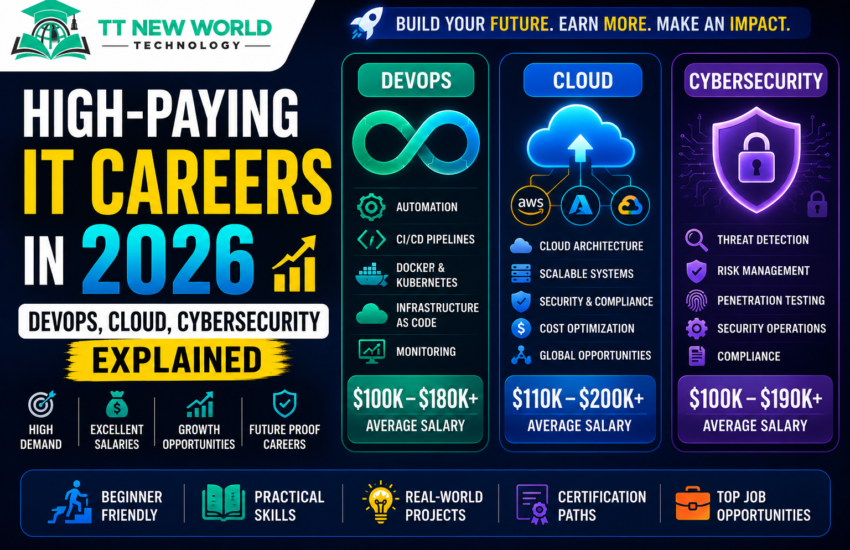
Technology is changing the world faster than ever before. Businesses are migrating to the cloud, automating operations, strengthening cybersecurity, and embracing artificial intelligence to stay competitive. As a result, the demand for skilled IT professionals continues to rise—and so do the salaries.
Whether you’re a student, career changer, recent graduate, or IT professional looking to specialize, choosing the right technology career can significantly impact your future.
But with so many options available, where should you begin?
Should you become a DevOps Engineer, a Cloud Engineer, a Cybersecurity Specialist, or pursue another fast-growing technology field?
In this guide, we’ll explore some of the highest-paying IT careers in 2026, what each role involves, the skills you’ll need, expected salaries, and how you can start your journey toward a rewarding career in technology.
Table of Contents
- Why IT Careers Are Growing
- What Makes an IT Career High Paying?
- Top High-Paying IT Careers
- DevOps Engineering
- Cloud Engineering
- Cybersecurity
- Site Reliability Engineering
- Cloud Architecture
- Data Engineering
- Artificial Intelligence & Machine Learning
- Career Comparison
- Certifications
- Learning Roadmap
- Frequently Asked Questions
- Final Thoughts
Why IT Careers Are Growing
Every industry now depends on technology.
Banks, hospitals, governments, retail companies, airlines, manufacturing firms, and startups all require skilled professionals to build, manage, and secure their digital infrastructure.
Businesses are investing heavily in:
- Cloud Computing
- Artificial Intelligence
- Cybersecurity
- Automation
- Data Analytics
- Digital Transformation
This demand has created thousands of well-paying job opportunities worldwide.
What Makes an IT Career High Paying?
High-paying technology careers generally involve solving complex business problems and managing critical systems.
These roles often require expertise in areas such as:
- Cloud platforms
- Automation
- Infrastructure
- Software development
- Security
- Networking
- Data management
- Artificial intelligence
The more specialized your skills become, the greater your earning potential.
1. DevOps Engineer
DevOps Engineers bridge the gap between software development and IT operations by automating software delivery and infrastructure management.
Responsibilities
- Build CI/CD pipelines
- Automate deployments
- Manage cloud infrastructure
- Configure Docker and Kubernetes
- Monitor applications
- Improve system reliability
- Implement Infrastructure as Code (IaC)
Skills to Learn
- Linux
- Git
- Docker
- Kubernetes
- Jenkins
- Terraform
- AWS
- Azure
- Google Cloud
- Bash
- Python
- Prometheus
- Grafana
Average Salary
- Entry Level: $70,000–$100,000
- Mid-Level: $100,000–$140,000
- Senior: $140,000–$190,000+
Best For
People who enjoy automation, cloud technologies, and solving infrastructure challenges.
2. Cloud Engineer
Cloud Engineers design, deploy, and manage cloud-based infrastructure that powers modern applications.
Responsibilities
- Build cloud infrastructure
- Manage virtual machines
- Configure networking
- Implement storage solutions
- Automate deployments
- Optimize cloud costs
- Ensure high availability
Popular Platforms
- Amazon Web Services (AWS)
- Microsoft Azure
- Google Cloud Platform (GCP)
Skills to Learn
- Networking
- Linux
- IAM
- Virtual Machines
- Cloud Storage
- Kubernetes
- Terraform
- Cloud Security
Average Salary
- Entry Level: $75,000–$105,000
- Mid-Level: $110,000–$150,000
- Senior: $150,000–$220,000+
Best For
Those who enjoy designing scalable infrastructure and working with cloud technologies.
3. Cybersecurity Specialist
Cybersecurity professionals protect organizations from cyber threats, data breaches, ransomware, and unauthorized access.
Responsibilities
- Monitor networks
- Perform vulnerability assessments
- Conduct penetration testing
- Investigate security incidents
- Implement security controls
- Manage identity and access
- Ensure compliance
Skills to Learn
- Networking
- Linux
- Windows Security
- Firewalls
- SIEM
- Ethical Hacking
- Risk Management
- Cloud Security
Average Salary
- Entry Level: $70,000–$100,000
- Mid-Level: $110,000–$150,000
- Senior: $150,000–$230,000+
Best For
Individuals who enjoy problem-solving, protecting systems, and staying ahead of emerging threats.
4. Site Reliability Engineer (SRE)
Site Reliability Engineers combine software engineering with operations to ensure systems remain reliable, scalable, and available.
Responsibilities
- Monitor infrastructure
- Improve system performance
- Automate operations
- Manage incident response
- Optimize reliability
- Reduce downtime
Skills
- Linux
- Kubernetes
- Prometheus
- Grafana
- Python
- Go
- Cloud Platforms
Average Salary
$120,000–$220,000+
5. Cloud Architect
Cloud Architects design complete cloud solutions for organizations.
They determine:
- Cloud strategy
- Infrastructure design
- Disaster recovery
- Security architecture
- Cost optimization
- Multi-cloud solutions
Skills
- AWS
- Azure
- Google Cloud
- Networking
- Kubernetes
- Security
- Terraform
Average Salary
$150,000–$250,000+
Cloud Architects are among the highest-paid professionals in IT.
6. Data Engineer
Every business generates enormous amounts of data.
Data Engineers build the systems that collect, transform, and deliver that data for analysis.
Responsibilities
- Build data pipelines
- Manage databases
- Process big data
- Design ETL workflows
- Support analytics teams
Skills
- SQL
- Python
- Apache Spark
- Kafka
- Airflow
- Snowflake
- Cloud Data Services
Average Salary
$110,000–$180,000+
7. Artificial Intelligence & Machine Learning Engineer
AI Engineers develop intelligent systems capable of learning from data and making predictions.
Responsibilities
- Build machine learning models
- Train AI algorithms
- Deploy AI applications
- Optimize model performance
- Integrate AI into products
Skills
- Python
- TensorFlow
- PyTorch
- Machine Learning
- Statistics
- Data Science
- Cloud AI Services
Average Salary
$130,000–$250,000+
Career Comparison
| Career | Difficulty | Demand | Salary Potential | Recommended For |
|---|---|---|---|---|
| DevOps Engineer | ⭐⭐⭐⭐ | ⭐⭐⭐⭐⭐ | ⭐⭐⭐⭐⭐ | Automation & Cloud |
| Cloud Engineer | ⭐⭐⭐ | ⭐⭐⭐⭐⭐ | ⭐⭐⭐⭐⭐ | Infrastructure |
| Cybersecurity Specialist | ⭐⭐⭐⭐ | ⭐⭐⭐⭐⭐ | ⭐⭐⭐⭐⭐ | Security & Risk |
| Site Reliability Engineer | ⭐⭐⭐⭐⭐ | ⭐⭐⭐⭐ | ⭐⭐⭐⭐⭐ | Reliability |
| Cloud Architect | ⭐⭐⭐⭐⭐ | ⭐⭐⭐⭐ | ⭐⭐⭐⭐⭐ | System Design |
| Data Engineer | ⭐⭐⭐⭐ | ⭐⭐⭐⭐ | ⭐⭐⭐⭐ | Data & Analytics |
| AI Engineer | ⭐⭐⭐⭐⭐ | ⭐⭐⭐⭐⭐ | ⭐⭐⭐⭐⭐ | Artificial Intelligence |
Which Career Should You Choose?
Choose DevOps if you enjoy:
- Automation
- Cloud computing
- Infrastructure
- Software delivery
- Problem-solving
Choose Cloud Engineering if you enjoy:
- Building scalable systems
- Networking
- Cloud architecture
- Infrastructure management
Choose Cybersecurity if you enjoy:
- Protecting systems
- Ethical hacking
- Investigating threats
- Risk management
Choose Artificial Intelligence if you enjoy:
- Mathematics
- Programming
- Data analysis
- Building intelligent systems
The best career is the one that aligns with your interests and strengths while offering opportunities for continuous growth.
Recommended Certifications
DevOps
- AWS Certified DevOps Engineer
- Certified Kubernetes Administrator (CKA)
- Terraform Associate
Cloud
- AWS Solutions Architect – Associate
- Azure Administrator (AZ-104)
- Google Associate Cloud Engineer
Cybersecurity
- CompTIA Security+
- Certified Ethical Hacker (CEH)
- CISSP (Advanced)
AI & Data
- Google Professional Machine Learning Engineer
- Microsoft Azure AI Engineer
- AWS Certified Machine Learning – Specialty
Learning Roadmap
If you’re starting from scratch:
Step 1
Learn Linux fundamentals.
Step 2
Master Git and GitHub.
Step 3
Learn networking basics.
Step 4
Study cloud computing (AWS is a great starting point).
Step 5
Learn Docker and Kubernetes.
Step 6
Understand Infrastructure as Code with Terraform.
Step 7
Build CI/CD pipelines using Jenkins or GitHub Actions.
Step 8
Learn monitoring with Prometheus and Grafana.
Step 9
Build real-world projects and publish them on GitHub.
Step 10
Earn relevant certifications and begin applying for roles.
This structured approach will help you build confidence and practical experience.
Frequently Asked Questions
Which IT career pays the most?
Cloud Architects, AI Engineers, and senior DevOps Engineers are among the highest-paid professionals in the technology industry. Compensation depends on experience, specialization, and location.
Can I start without a computer science degree?
Yes. Many professionals enter IT through self-study, certifications, bootcamps, and hands-on projects. Employers increasingly value demonstrable skills over formal degrees.
Which career is best for beginners?
Cloud Engineering and DevOps provide strong foundations because they expose you to infrastructure, automation, networking, and cloud technologies that are useful across many IT roles.
How long does it take to become job-ready?
With consistent learning and practical experience, many beginners can become ready for entry-level positions within 6–12 months.
Final Thoughts
The technology industry offers more opportunities than ever before, and the demand for skilled professionals continues to grow across cloud computing, DevOps, cybersecurity, data engineering, and artificial intelligence.
While salaries are attractive, long-term success comes from building practical skills, staying curious, and continuously learning as technologies evolve.
At TT New World Technology, we are committed to helping students and professionals gain the knowledge and hands-on experience needed to thrive in today’s competitive IT landscape. Our instructor-led programs cover Linux, Cloud Computing, DevOps, Kubernetes, Cybersecurity, Artificial Intelligence, and more—equipping you with the skills employers value most.
Your future in technology starts with one decision: begin learning today, build practical experience, and position yourself for one of the most rewarding careers of the digital age.
