
Imagine you’re using your favorite banking app, shopping online, or scrolling through social media. Every few days—or even every few hours—you notice new features, bug fixes, and performance improvements appearing without interruption. Have you ever wondered how companies like Amazon, Netflix, Google, and Facebook release software so quickly and reliably?
The answer lies in CI/CD.
Continuous Integration (CI) and Continuous Delivery/Deployment (CD) have revolutionized software development by enabling teams to build, test, and deploy applications automatically. Instead of waiting weeks or months for updates, modern organizations can release new features multiple times a day with confidence.
In this beginner-friendly guide, we’ll explain CI/CD in simple terms, explore how it works, examine the tools involved, and show why every developer, DevOps engineer, and cloud professional should understand it.
Table of Contents
- What is CI/CD?
- Why CI/CD Matters
- Understanding Continuous Integration (CI)
- Understanding Continuous Delivery (CD)
- Continuous Delivery vs Continuous Deployment
- The CI/CD Pipeline Explained
- Popular CI/CD Tools
- Benefits of CI/CD
- Challenges of Implementing CI/CD
- Best Practices
- CI/CD in the Cloud
- Career Opportunities
- Frequently Asked Questions
- Final Thoughts
What is CI/CD?
CI/CD stands for:
- Continuous Integration (CI)
- Continuous Delivery (CD) or Continuous Deployment (CD)
It is a modern software development practice that automates the process of building, testing, and deploying applications.
Instead of manually performing these tasks, automation ensures that every code change is validated and delivered quickly, consistently, and safely.
Think of CI/CD as an automated production line for software.
Just as a car factory uses robots to assemble vehicles efficiently, CI/CD uses automation to build and deliver software faster and with fewer errors.
Why CI/CD Matters
Traditional software development often looked like this:
- Developers wrote code for weeks or months.
- Teams manually tested the application.
- Deployments happened late at night or on weekends.
- Bugs were discovered after release.
- Rolling back changes was difficult and time-consuming.
This approach led to long release cycles, increased risk, and frustrated customers.
CI/CD solves these challenges by introducing automation into every stage of the software delivery process.
Benefits include:
- Faster software releases
- Improved code quality
- Fewer deployment failures
- Reduced manual work
- Faster feedback
- Greater collaboration
- Increased customer satisfaction
What is Continuous Integration (CI)?
Continuous Integration is the practice of frequently merging code changes into a shared repository.
Every time a developer pushes new code, an automated pipeline immediately begins.
The pipeline typically performs tasks such as:
- Downloading the latest code
- Compiling the application
- Running unit tests
- Performing code quality analysis
- Executing security scans
- Packaging the application
If any step fails, the developer is notified immediately so the issue can be fixed before it reaches production.
Why Continuous Integration is Important
Without CI, developers often work independently for long periods. When it’s time to merge changes, conflicts and unexpected bugs become common.
CI helps teams:
- Detect problems early
- Reduce integration conflicts
- Improve collaboration
- Maintain a stable codebase
What is Continuous Delivery (CD)?
Continuous Delivery extends Continuous Integration by ensuring that applications are always ready for deployment.
After passing all automated tests, the application is packaged and deployed to staging or pre-production environments.
A final approval is typically required before releasing to production.
This allows organizations to deploy whenever the business is ready.
What is Continuous Deployment?
Continuous Deployment takes automation one step further.
Every successful code change that passes automated testing is automatically deployed directly into production without requiring manual approval.
Companies like Netflix, Amazon, and Facebook use Continuous Deployment to release updates continuously throughout the day.
Continuous Delivery vs Continuous Deployment
| Continuous Delivery | Continuous Deployment |
|---|---|
| Requires manual approval before production | Deploys automatically to production |
| Gives teams greater release control | Maximizes speed and automation |
| Common in enterprise environments | Popular among highly automated organizations |
Both approaches rely on the same automated testing and validation processes. The primary difference is whether a human approval step is included before production deployment.
The CI/CD Pipeline Explained
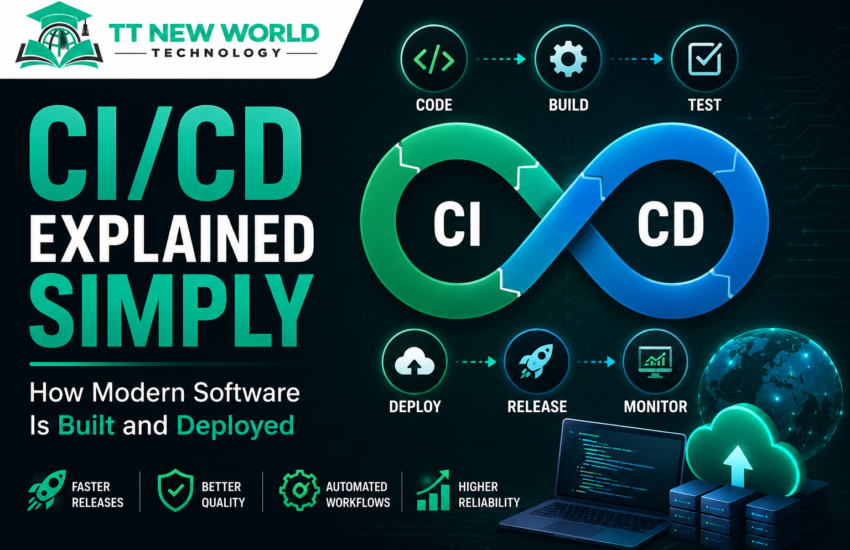
A CI/CD pipeline is a sequence of automated stages that every code change follows before reaching users.
Stage 1: Code
Developers write code and push it to a version control system such as GitHub or GitLab.
Stage 2: Build
The pipeline compiles the application and prepares executable artifacts.
Stage 3: Test
Automated tests verify functionality, performance, and security.
Common tests include:
- Unit tests
- Integration tests
- Security scans
- Static code analysis
Stage 4: Package
The application is packaged into deployable artifacts such as:
- Docker Images
- JAR files
- WAR files
- ZIP packages
Stage 5: Deploy
The application is deployed to staging or production environments.
Modern deployments often use Kubernetes, cloud platforms, or virtual machines.
Stage 6: Monitor
After deployment, monitoring tools track application health, performance, and user experience.
If issues are detected, alerts notify the engineering team immediately.
Popular CI/CD Tools
Several powerful tools help automate CI/CD pipelines.
Git
Stores source code and tracks every change made by developers.
Jenkins
One of the world’s most popular automation servers for building CI/CD pipelines.
GitHub Actions
Allows CI/CD workflows directly within GitHub repositories.
GitLab CI/CD
Provides integrated DevOps automation inside GitLab.
Azure DevOps
Microsoft’s complete DevOps platform with CI/CD capabilities.
CircleCI
A cloud-native CI/CD platform designed for fast, scalable automation.
How Docker and Kubernetes Fit In
CI/CD often works together with container technologies.
Docker
Packages applications and their dependencies into portable containers.
Kubernetes
Deploys, scales, and manages those containers automatically.
Together, Docker and Kubernetes ensure that applications behave consistently across development, testing, and production environments.
CI/CD in the Cloud
Modern organizations rarely build software on local servers alone.
Cloud platforms provide powerful CI/CD services.
AWS
- CodeCommit
- CodeBuild
- CodeDeploy
- CodePipeline
Microsoft Azure
- Azure DevOps
- Azure Pipelines
- Azure Repos
Google Cloud
- Cloud Build
- Cloud Deploy
- Cloud Source Repositories
These services integrate with Git repositories, testing frameworks, and deployment platforms to automate the entire software delivery lifecycle.
Benefits of CI/CD
Organizations implementing CI/CD experience significant improvements, including:
- Faster software delivery
- Higher code quality
- Automated testing
- Reduced deployment risks
- Faster bug detection
- Easier rollbacks
- Increased developer productivity
- Better collaboration between development and operations teams
- More reliable releases
- Improved customer satisfaction
Common Challenges
While CI/CD offers tremendous advantages, successful implementation requires planning.
Common challenges include:
- Poor test coverage
- Legacy applications
- Complex deployment environments
- Cultural resistance to automation
- Inadequate monitoring
- Security integration
Addressing these challenges gradually helps organizations maximize the value of CI/CD.
Best Practices
To build an effective CI/CD pipeline:
- Commit code frequently.
- Automate testing at every stage.
- Keep builds fast and reliable.
- Store infrastructure as code.
- Monitor deployments continuously.
- Secure the pipeline with automated security checks.
- Use version control for everything, including infrastructure and configuration.
These practices improve reliability and reduce deployment failures.
Career Opportunities
Understanding CI/CD is essential for many modern technology roles, including:
- DevOps Engineer
- Software Engineer
- Cloud Engineer
- Site Reliability Engineer (SRE)
- Platform Engineer
- Release Engineer
- Automation Engineer
Employers increasingly expect professionals to understand CI/CD pipelines, automation tools, and cloud-native deployment practices.
Frequently Asked Questions
Is CI/CD difficult to learn?
Not at all. Once you understand the basic concepts of version control, automation, and testing, CI/CD becomes much easier to grasp through hands-on practice.
Which CI/CD tool should I learn first?
Jenkins remains an excellent choice because it is widely used and teaches the core principles of pipeline automation. GitHub Actions and GitLab CI/CD are also popular, especially for teams already using those platforms.
Do I need to know programming?
Basic scripting knowledge in Bash or Python is helpful, but you don’t need to be an expert software developer to begin learning CI/CD.
Can CI/CD be used with cloud platforms?
Yes. CI/CD integrates seamlessly with AWS, Microsoft Azure, Google Cloud, Kubernetes, Docker, and many other technologies.
Final Thoughts
CI/CD has transformed the way modern software is built and delivered. By automating building, testing, and deployment, organizations can release software faster, improve quality, and respond to customer needs with greater confidence.
Whether you’re pursuing a career in DevOps, cloud computing, software engineering, or platform engineering, understanding CI/CD is a foundational skill that will set you apart in today’s technology landscape.
At TT New World Technology, our instructor-led DevOps training program provides hands-on experience with Git, Jenkins, Docker, Kubernetes, Terraform, cloud platforms, and complete CI/CD pipeline implementation. You’ll build real-world projects, gain practical experience, and develop the skills employers are actively seeking.
Start learning CI/CD today—and discover how modern software is built, tested, and deployed with speed, reliability, and confidence.
