
Technology is evolving at an unprecedented pace, and organizations are under constant pressure to deliver software faster, more securely, and with higher reliability. Traditional software development methods often create silos between development teams and IT operations, leading to slow releases, communication gaps, and frequent production issues.
This is where DevOps comes in.
DevOps has become one of the most in-demand technology skills worldwide, helping organizations automate software delivery, improve collaboration, and release applications more frequently with fewer failures. Whether you’re an aspiring software engineer, system administrator, cloud architect, or IT professional looking to advance your career, learning DevOps can open doors to exciting opportunities.
In this comprehensive guide, we’ll explore everything you need to know about DevOps—from its fundamentals to advanced concepts, tools, best practices, and career opportunities in 2026.
Table of Contents
- What is DevOps?
- Why DevOps Matters
- The History of DevOps
- Core Principles of DevOps
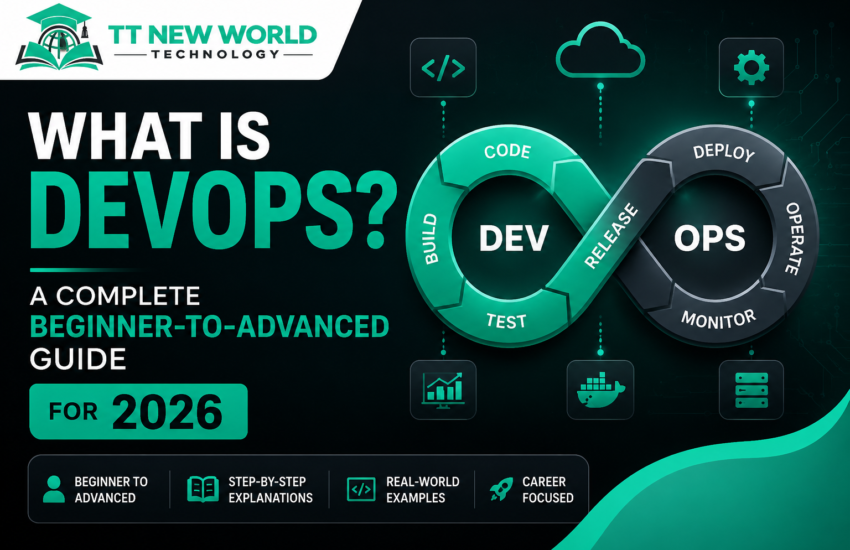
- The DevOps Lifecycle
- DevOps Culture
- Popular DevOps Tools
- DevOps Pipeline Explained
- DevOps on Cloud Platforms
- DevSecOps
- Monitoring and Observability
- Infrastructure as Code
- Containers and Kubernetes
- CI/CD Pipelines
- DevOps Career Opportunities
- Salary Expectations
- Learning Roadmap
- Frequently Asked Questions
- Conclusion
What is DevOps?
DevOps is a combination of Development (Dev) and Operations (Ops) that focuses on improving collaboration between software developers and IT operations teams.
Rather than working independently, both teams collaborate throughout the software development lifecycle using automation, continuous integration, continuous delivery, and monitoring.
The goal is simple:
- Deliver software faster
- Reduce deployment failures
- Improve collaboration
- Increase system reliability
- Automate repetitive tasks
- Enhance customer satisfaction
Think of DevOps as both a culture and a technical practice that enables organizations to build, test, deploy, and maintain applications efficiently.
Why is DevOps Important?
Modern businesses release software updates daily—or even multiple times per day. Without DevOps, this would be extremely difficult.
DevOps helps organizations:
- Accelerate software delivery
- Improve software quality
- Reduce downtime
- Automate manual processes
- Detect issues earlier
- Recover quickly from failures
- Scale infrastructure efficiently
- Improve collaboration between teams
Companies like Amazon, Netflix, Google, Microsoft, Facebook, and Spotify rely heavily on DevOps practices to maintain their competitive edge.
Traditional Development vs DevOps
| Traditional IT | DevOps |
|---|---|
| Separate Development & Operations teams | Shared responsibility |
| Manual deployments | Automated deployments |
| Slow software releases | Continuous delivery |
| Limited communication | Continuous collaboration |
| Reactive monitoring | Proactive monitoring |
| Long release cycles | Frequent releases |
The Evolution of DevOps
Before DevOps:
Developer → Tester → Operations → Customer
Each team worked independently, causing delays and communication challenges.
Today:
Developer → Automated Testing → CI/CD → Infrastructure Automation → Monitoring → Customer Feedback
Everything is automated and integrated into a continuous delivery pipeline.
Core Principles of DevOps
Successful DevOps practices are built around several key principles:
Collaboration
Development, operations, quality assurance, and security teams work together throughout the software lifecycle.
Automation
Automation eliminates repetitive manual tasks such as:
- Building applications
- Running tests
- Deploying software
- Configuring infrastructure
- Monitoring systems
Continuous Integration (CI)
Developers frequently merge code into a shared repository, where automated builds and tests validate every change.
Continuous Delivery (CD)
Applications are always kept in a deployable state, allowing new features and fixes to reach users quickly and safely.
Continuous Monitoring
Applications and infrastructure are continuously monitored to detect issues before they impact users.
The DevOps Lifecycle
A typical DevOps lifecycle includes:
- Planning
- Development
- Build
- Testing
- Release
- Deployment
- Operations
- Monitoring
- Feedback
- Continuous Improvement
Each stage is connected through automation and collaboration.
Popular DevOps Tools
A modern DevOps toolchain often includes:
Version Control
- Git
- GitHub
- GitLab
- Bitbucket
CI/CD
- Jenkins
- GitHub Actions
- GitLab CI/CD
- Azure DevOps
- CircleCI
Containers
- Docker
- Podman
Container Orchestration
- Kubernetes
- OpenShift
- Amazon EKS
- Azure AKS
- Google GKE
Infrastructure as Code
- Terraform
- AWS CloudFormation
- Pulumi
- Ansible
Configuration Management
- Ansible
- Puppet
- Chef
- SaltStack
Monitoring
- Prometheus
- Grafana
- Elasticsearch
- Kibana
- Loki
- Datadog
- New Relic
Cloud Platforms
- Amazon Web Services (AWS)
- Microsoft Azure
- Google Cloud Platform (GCP)
CI/CD Explained
Continuous Integration (CI)
Every code change automatically:
- Builds the application
- Runs unit tests
- Performs security scans
- Validates code quality
Continuous Delivery (CD)
After successful testing, applications are automatically prepared—or deployed—for production.
Benefits include:
- Faster releases
- Lower deployment risk
- Higher software quality
- Easier rollbacks
Infrastructure as Code (IaC)
Infrastructure is no longer created manually.
Instead, servers, networks, databases, and cloud resources are defined in code.
Example tools:
- Terraform
- AWS CloudFormation
- Pulumi
Benefits:
- Repeatable deployments
- Version-controlled infrastructure
- Reduced configuration drift
- Faster provisioning
Containers and Kubernetes
Containers package applications with all their dependencies, ensuring consistent behavior across environments.
Docker is the most widely used container platform.
Kubernetes manages containerized applications by providing:
- Automatic scaling
- Load balancing
- Self-healing
- Rolling updates
- High availability
DevSecOps
Security is no longer an afterthought.
DevSecOps integrates security into every stage of the DevOps lifecycle.
Common practices include:
- Static code analysis
- Dependency scanning
- Container image scanning
- Secrets management
- Compliance checks
- Automated vulnerability testing
Monitoring and Observability
Deploying software is only part of the journey. Teams must also understand how applications behave in production.
Observability combines:
- Metrics
- Logs
- Traces
Popular tools include:
- Prometheus
- Grafana
- Elasticsearch
- Kibana
- OpenTelemetry
These tools help teams detect issues quickly, troubleshoot problems, and optimize performance.
Cloud and DevOps
Cloud platforms are the foundation of modern DevOps.
They provide:
- Elastic infrastructure
- Managed Kubernetes
- Serverless computing
- CI/CD services
- Monitoring tools
- Security services
The three leading cloud providers are:
- Amazon Web Services (AWS)
- Microsoft Azure
- Google Cloud Platform (GCP)
Benefits of DevOps
Organizations adopting DevOps often experience:
- Faster software delivery
- Improved collaboration
- Increased deployment frequency
- Better software quality
- Reduced downtime
- Improved customer satisfaction
- Lower operational costs
- Enhanced scalability
- Faster incident recovery
- Greater business agility
Common Challenges
Despite its advantages, implementing DevOps comes with challenges:
- Cultural resistance
- Legacy systems
- Lack of automation
- Skill gaps
- Security concerns
- Tool complexity
Successful adoption requires leadership support, continuous learning, and gradual implementation.
DevOps Career Opportunities
The demand for DevOps professionals continues to grow globally.
Popular roles include:
- DevOps Engineer
- Cloud Engineer
- Site Reliability Engineer (SRE)
- Platform Engineer
- Release Engineer
- Automation Engineer
- Infrastructure Engineer
- Kubernetes Administrator
- Cloud Architect
Salary Expectations (2026)
While salaries vary by location and experience, DevOps professionals remain among the highest-paid IT specialists.
Approximate annual salaries:
- Entry Level: $70,000–$100,000
- Mid-Level: $100,000–$140,000
- Senior: $140,000–$200,000+
- Cloud/DevOps Architect: $180,000–$250,000+
DevOps Learning Roadmap
If you’re starting from scratch, follow this roadmap:
- Learn Linux fundamentals
- Master Git and GitHub
- Understand networking basics
- Learn scripting (Bash/Python)
- Study cloud computing
- Learn Docker
- Learn Kubernetes
- Master Terraform
- Build CI/CD pipelines with Jenkins or GitHub Actions
- Learn monitoring and logging
- Study security and DevSecOps
- Build real-world projects and contribute to open source
Consistency and hands-on practice are key to becoming a successful DevOps engineer.
Frequently Asked Questions
Is DevOps difficult to learn?
DevOps has a broad scope, but with a structured learning path and consistent practice, beginners can gradually build the necessary skills.
Do I need programming knowledge?
Basic scripting in Bash or Python is highly recommended, but you don’t need to be an expert software developer to start.
Is DevOps only for cloud engineers?
No. DevOps practices are valuable for software developers, system administrators, QA engineers, security professionals, and IT operations teams.
Which cloud platform should I learn first?
AWS is the most widely adopted, but Azure and Google Cloud Platform are also excellent choices depending on your career goals.
Final Thoughts
DevOps is more than a collection of tools—it’s a culture that transforms how teams build, deliver, and maintain software. By embracing collaboration, automation, continuous integration, continuous delivery, and observability, organizations can deliver higher-quality software faster and more reliably.
As businesses continue to invest in cloud computing, automation, artificial intelligence, and modern application development, DevOps skills will remain in high demand throughout 2026 and beyond.
Whether you’re beginning your IT journey or looking to advance your career, now is the perfect time to learn DevOps.
At TT New World Technology, we offer hands-on, instructor-led training designed to equip you with the practical skills employers are looking for. From Linux and Git to Docker, Kubernetes, Terraform, CI/CD, cloud platforms, and real-world DevOps projects, our programs prepare you to succeed in today’s technology-driven world.
Start your DevOps journey today—and build the skills to shape the future of software delivery.
